
Gray - An Elderly Friendly Brand
Building an inclusive brand named Gray and designing a mobile bookshelf cum walker
Duration: 11 days
Project Type: Brand Design, Logo Design, Product Design
Tools: Rhino, Figma, Metal Workshop Tools and Wood Workshop Tools
Keywords: User Research, Elderly, Inclusive Design, Accessibility
Project Overview: Having lived with my grandparents, I understand the challenges the elderly face in their daily lives. I observed that many brands targeting the elderly are either tech-focused or create products that foster dependency. Wishing to change this narrative, I set out to design an inclusive brand, backed up by robust user research, that empowers the elderly.
For those who want a quick 2 minute glance, this is how the project went...

So, where did it all begin?
Having lived with my grandparents on and off my entire life, I have witnessed ageing first hand. One of my biggest realisations as I grew older is that ageing, an inevitable process, is not only about the physical and emotional changes but also involves the adaptation to daily lives. Unfortunately, daily life products or routines that suited them when they were much younger becomes a pain to use or follow when they are much older. The biggest reason for this is, the daily use products do not consider the different needs and requirements ageing rises.
Thus, annoyed at how most products are not elderly friendly, and realising the huge gap in the market, I decided to design a brand that focusses on the needs of elderly. Though the motivation to start the brand was personal, the idea behind this brand is backed up by statistics, research and insightful data.
Further, I ensured none of my experiences, feelings or thoughts bias this project and detached myself from this project at this very stage. And with this, the project commenced.
User Research 👤👤
Whose problem am I trying to solve?
Every Single Grandparent 👵👴.
Research states, by 2030, one in six people will be 60 years or older, leading to a population increase from 1 billion (2020) to 1.4 billion. Thus, a deliberate choice, based on the surge in elderly population, was made to place elderly users as the cornerstone of the brand’s primary user persona and offerings. Further, a significant gap in the market was discerned where everyday products and furniture often failed to meet the unique needs of this demographic.
Most products existing in the market, inadvertently increased the elderly's dependence and prioritised safety over comfort. Based on this finding, the brand pivoted towards crafting comfortable experiences for the elderly, placing a strong emphasis on fostering independence and empowerment.

Product Research 👤👤
I have a brand, but what is the brand selling?
.png)

CHALLENGES
-
Hearing Issues
-
Absence of mind
-
Staying Home all day
-
Lack of transport
-
Comfort in Home
-
Staying Independent
-
Affordability
NEEDS
-
Healthcare Needs
-
Safety & Comfort Needs
-
Transportation Needs
-
Emotional Wellbeing
-
Technology Needs
-
Being Independent & Safe
GOALS
-
To explore new places
-
Strengthen family bonds &create lasting memories
-
To remain healthy & Independent
-
To stay entertained
Getting to really know my users
Jaya and Chokkanathan are a typical elderly couple, who love being independent, cooking their own food, going out to new places and exploring the city they are in. They go on regular walks every evening to stay fit. However, due to age catching up, they are not able to go out as often as they would like to. Thus, staying at home allday, drives them mad.

How do I name a brand designed for elderly?
I wanted to capture the beauty of aging and make growing old feel strong and comfortable. The brand aimed to empower the elderly, making their lives easier and challenging the idea that old age means fragility. The brand's core mission was to empower the elderly, enhancing their capabilities and making the aging experience more manageable. The chosen name aimed to challenge conventional views on aging and inspire a shift in perspective, emphasizing strength and independence in the elderly.


With my assumptions bust, how do I move ahead? 🚨
While introducing new activities in our intervention area is currently off the table, I tried identifying opportunities to enhance the existing routines of the elderly. This particular timeframe, which encompasses a significant portion of their day, is typically filled with activities such as reading, watching TV, conversing with family, or simply resting. While I cannot address their sleeping habits, there are other areas where improvements can be made.

Validating Assumptions through Interviews 🗣️
To validate my assumptions, I conducted one-on-one interviews with retired middle-class individuals in Yelahanka, Bangalore. Here's what I found:
KEY FINDINGS
-
Desire for Independence: Most elderly individuals preferred being independent, even if they lived with their children.
-
Dependency: Out of ten interviewees, eight lived with their children due to physical, emotional, or financial dependencies.
-
Active Lifestyles: Nine out of ten had hobbies like reading or walking.
-
Desire to Stay Active: Every interviewee wanted to remain active.
RESISTANCE TO CHANGE
A significant finding was their resistance to change. Despite expressing boredom, many were reluctant to try new activities, acquire new skills, or alter their routines. Their dependency on family might influence this reluctance.
CONCLUSION
Intervening in areas where the elderly show little interest in change seems unproductive. This direction of intervention appears blocked.
🪑 REDESIGNING CHERISHED FURNITURE
During a conversation with one elderly individual, they mentioned their inability to enjoy their favorite wooden chair due to age-related back pain. This sparked an idea: what if we redesign cherished furniture to make it more comfortable for the elderly? Another person I spoke with had undergone knee replacement surgery, which limited their ability to stand in the kitchen while cooking. Why not create a kitchen setup where they can comfortably sit and prepare meals, allowing them to continue enjoying cooking without straining their knees?
📖 ENHANCING READING EXPERIENCES
Reflecting on my interactions, I considered how to enhance the elderly's engagement with their hobbies. I discovered that a significant portion of the elderly population participates in indoor activities such as reading. With this insight, I started exploring ways to improve the reading experience for the elderly. I began by observing elderly individuals as they read and drafted a customer journey map to better understand their reading habits and the pain points they face. This approach provided valuable insights into how we can enhance their reading experiences and overall quality of life.
Ideation & Prototyping 💡⚒️
How do I translate my ideas into a product?
Conceptualizing the Mobile Bookshelf 💡
Based on insights from my customer journey map, a significant concern emerged: elderly individuals often struggle with limited space to store their books, and accessing them from TV cabinets or drawers in their Puja (prayer) rooms can be inconvenient. To address this issue, I initiated a project to design a mobile bookshelf specifically tailored for the elderly. This solution allows them to easily reach their favorite books while seated comfortably on sofas or lying in bed, eliminating the need for strenuous movements like bending or stretching.
📚 KEY FEATURES FOR ENHANCED USABILITY
To further enhance usability, I added three thoughtful features
CONVENIENT FOOTREST
For added comfort while reading on the sofa.
PRACTICAL
For storing tablets, reading glasses, and other essentials.
WALKER DESIGN
The bookshelf will take the shape, form, and dimensions of a walker to maximize usability for the elderly.
Making prototypes to visualise in 3D
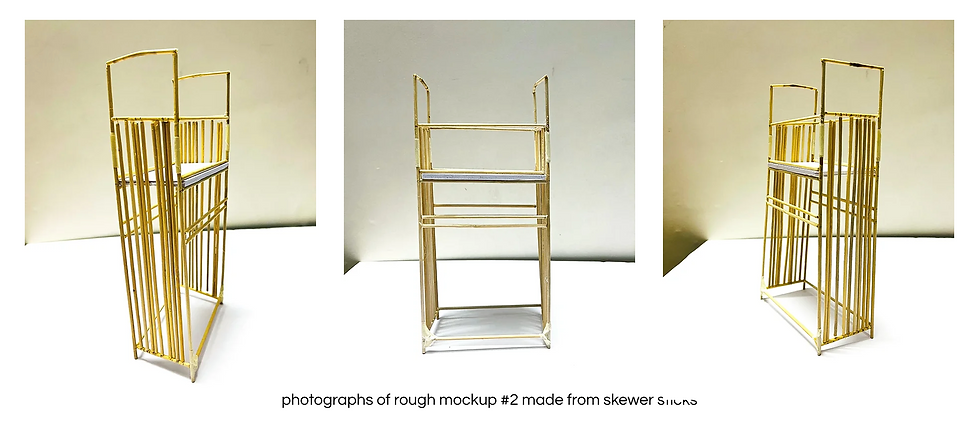
To better understand the 3D model, I created a rough prototype using simple paper straws. This basic model helped visualize the shape and form, allowing me to determine the product's dimensions and identify some design issues.


Identifying Design Challenges
Initially, I considered adding a metal backing to one side of the bookshelf for stability, but this would hinder accessibility, requiring the elderly to rotate it, which would demand more effort. Realizing this, I brainstormed better solutions. A revolving shelf still required effort, and leaving both sides open risked books falling off. Prototyping revealed these challenges, prompting me to explore more innovative solutions.
Refining the Prototype
After identifying issues in the initial prototype, I created a more precise 1:5 scale model using barbecue skewer sticks for accuracy and measured specific dimensions, considering the average width of existing drawers used by the elderly. To prevent books from falling off, I added rods on top of the shelves, adjusted the length to match a walker, and ensured the height was accessible for someone sitting on a sofa or bed. This iteration revealed that the height was unnecessarily long and didn't align with a walker's dimensions, helping refine the design and make it more practical.



3D Digital Modelling & Making
After making the mockups, I reassessed the dimensions for precision and transitioned to Rhino for modeling, which provided a lifelike representation of the final product. Using Rhino allowed for comprehensive testing and visualization of various color schemes and materials, ensuring a harmonious and cohesive design. Additionally, the 3D model helped determine the exact dimensions of each metal rod, welding points, and the required length of metal pipes, giving me a thorough understanding of the metalworking involved.


The Outcome 🎬
What was my final outcome?

Drawing to visualise a form
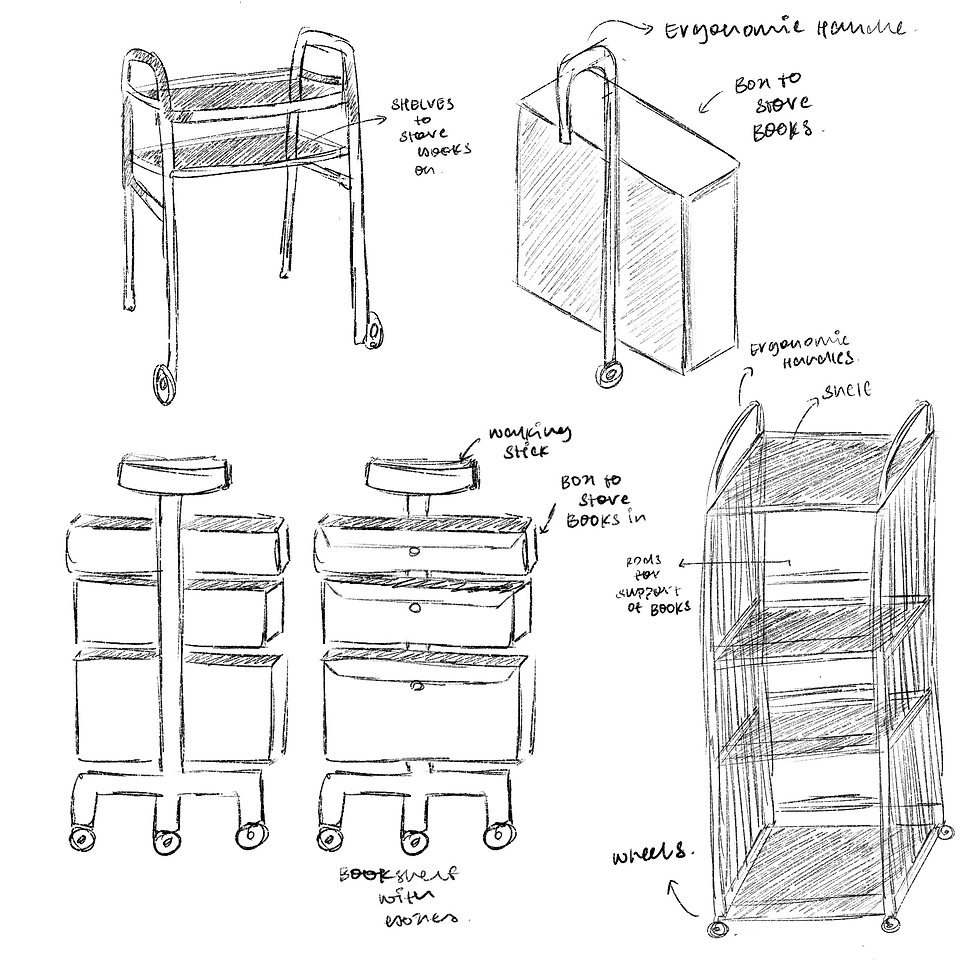
I began ideating different forms for my product by sketching out various possibilities. Combining a walker with a bookshelf for the elderly helped me conceptualize multiple designs. While sketching translated my ideas into visual representations, I still lacked clarity on dimensions and usability.
Brand Name ❝❞
What's in a name?
How does aalamaram as a brand name sound?
Based on the word cloud I created, I shortlisted two primary brand names: Aalamaram and Grey. I chose to go ahead with Aalamaram (the Tamil translation of banyan tree) to signify strength in the elderly. The name, associated with a tree, evoked a sense of nature and medicine. I began by brainstorming various logo concepts for Aalamaram. After finalising a logo, I used Google's image search to identify similar logos and the brands they represented.


aalamaram didn't work, so I had to rethink...
Upon reflection, I noticed that the logos I designed for Aalamaram gave off a vibe more suited for a natural medicine brand than one empowering the elderly. Plus, the name itself had an Indian undertone, possibly limiting its global appeal. Wanting to avoid these limitations, I opted for 'Grey' after careful consideration. 'Grey' symbolises one of the earliest signs of aging—grey hair—yet my aim is to spin it into something positive and appealing. Moreover, its English language usage gives it an international appeal. Here are some iterations:


And then came the final logo & brand name...
After numerous iterations and careful thought, I finally landed on a logo and colour scheme that truly captured the brand's essence. I chose a vibrant yellow to symbolise hope, diverging from the softer hues typical of competitors to bring more energy into the lives of the elderly. One of my favourite parts of the design process was reimagining the letter 'A' in the logo. By transforming it into a user icon, I emphasised the brand's human-centric focus, making it clear that this brand is all about the people it serves.


Now that I had a brand designed exclusively for elderly, I had to come up with a product the brand could sell. How?
While I had done some rudimentary research on my users, I still didn't really know my users. So, I started off by designing an user persona, and simultaneously identifying their needs, wants & challenges etc. Further, I decided to map out their day-to-day lives to help me identify an area of intersection. Since I live with my grandparents, and have interacted with multiple elderly people before, I know, elderly people are people of habit. Thus, mapping out their day could really give a great insight into their lives, and help me identify products they need/want.
Learnings & Reflection 🧠
What comes out of this journey?
Learning to prototype & working with metal
This project marked my first experience working with metal as a material, offering a deep dive into metalworking processes. I learned to bend metal, angle grind, spot weld, and drill through metal pipes, gaining firsthand insights into metal properties. Given the project's tight 11-day timeframe, I quickly adapted and developed new skills. This rapid-paced environment introduced me to the concept of rapid prototyping, a pivotal skill in product design.
Learning 3D Modelling & Designing a Physical Product
This was also my first time using Rhino for 3D modeling. Throughout the project, I navigated the design process of creating a full-fledged physical product, involving multiple iterations. I learned to consider additional factors when designing inclusive physical products, such as understanding anthropometric data. The experience was a steep learning curve, enhancing my ability to design and model efficiently.
What would I do if I had more time?
Although I created numerous prototypes and iterations during this project, I didn't allocate much attention to the final usability testing phase. Initially, I only conducted basic functional tests with my grandparents. However, ideally, the prototype should undergo testing with a broader range of elderly individuals, including those with diverse physical and mental needs, such as arthritis. Additionally, testing on different types of flooring is necessary.
A more comprehensive user research approach could identify additional features, such as enhancing portability for maneuvering between different locations. If given more time, I would expand my research network and conduct prototype testing with a wider audience under various conditions.