
Music x Work From Home (WFH)
Reimagining Music for a WFH Scenario ft. Spotify
Duration: 12 Weeks
Time Period: Sep 2021 - Nov 2021
Project Type: Product Design, Collaborative Passion Project
Tools: Figma, Miro, Spotify, Zoom, Canva (Illustrations), Freepik
Team: Collaborative Project with Keerthana
Keywords: User Experience Design, Product Design, Diary Study, UX Research
Project Overview: Aiming to identify pain points in the music streaming experience, Keerthana and I joint hands in employing a UX Research Methodology, online diary studies to solve problems. We ended up realizing that the solution for the problem identified need not be a stand-alone and decided to create a product feature for the globally acclaimed music streaming app, Spotify.
The Outcome 🎬
What was my final outcome?
It all began with forming an A team!
Keerthana and I have been friends since high school. From cribbing over our Math IA’s (IB Students, you can relate!) to being confused over our career paths and attending our architecture interview together we have been through a huge journey. However, in college apart from occassionally bumping into each other, we lost touch. What started off as a Instagram story reply, ended up in realising we both were passionate about UX Design. This was the seed of this project. Fast forward, after gazillion ranting calls and a few project discussion calls here we are presenting our first (and definetly not the last) collaborative study; Re-imagining music.

📝
A tiny disclaimer
The case study mirrors the structure of our project. Unlike conventional case studies, most sections were written during the project rather than following the typical problem statement -> research -> ideate -> solution format, as we started without a clear problem statement.
This approach made our project more interesting and unique. At each stage, we were eager to see where it would lead. Therefore, our case study reads more like a journal of our experiences, learnings, and emotions rather than a formal document.
Firstly, why music 🎶?
Let’s be real. We all love music. But how many of us are going to pay for a music streaming app? How many times do we have a tune stuck in our head with no clue about the song? Remember the times when we keep skipping songs from our playlist till we find the perfect music?
Music is a huge industry, and each day more songs get released, more artists come to fame and more albums are obsessed over. Music Streaming Apps are thriving. There has never been more competition ever. However, are they perfect? Personally, as a student, I don’t subscribe to any music streaming apps. I simply can’t afford it. Sometimes, I find the interfaces difficult to use. I just can’t find the perfect song and creating a playlist from scratch is time-consuming. The problems I face with music streaming apps are countless. I am also a user, right? I had to test if others also had issues just like I did 🤷🏻♀️
As engineering students, we know the potential of Artificial Intelligence (AI) and Natural Language Processing (NLP). I was just curious why it hasn’t yet been implemented in music streaming apps. That was the first thought on starting a passion study to improve music streaming experience for users (also the statistics below).
68%
adults aged between 18 and 34 years old reported to listening to music everyday. (Source)
Music is a large part of people’s lives!
56%
of the 23.1 billion US Dollar revenue of the recorded music industry was from streaming. (Source)
Music Streaming does bring in loads of profit!
32%
of growth in the on-demand audio streams in United States between 2018 and 2019. (Source)
There is so much potential for growth!
Initial Problem Statement ⁉️
What are we trying to solve?
Uhm, we didn't have a problem statement and were clueless on how and where to begin. This became a problem in itself .
However, the biggest problem we faced was - Where do we start? How do we start? We did not have a problem statement to start off with. Doing background research to find a problem statement is cumbersome due to the large scale industry we are targeting. However, we did not want to give up on this project. After loads of research, we discovered a gem - Online Diary Studies. With this exciting methodology discovered, we were enthusiastic to have this project started ASAP and that’s where project “Re-imagining Music” came to form. Re-inventing Music Streaming Experience.
Since we did not have a problem statement, we chose to try out diary studies to identify a potential problem to solve.
Diary studies are user research methodologies adopted to find in-depth, qualitative data about user experience (UX). Data on user behaviours, activities and experiences over an extended period of time is collected to observe patterns and identify issues. In diary studies, usually, user’s are asked to make diary/journal entries about their experience with a particular product/service. The data collected from diary studies are rich in information regarding the motivations, pain points and habits of users. The primary advantage of employing this methodology is its versatility; it can be used at any point in the project/user research. Further, it provides data as specific or as broad as required.
The biggest advantage we had by adopting this methodology is the versatility.
Thus, we listed down few boundaries such as the target group, the period during which we would be conducting the research and listed down a few prompts and instructions that might aid our participants for the online diary study. Upon deciding these boundaries, due to the con of finding participants, we instantly reached out to a large group of people within our target group requesting them to participate. We used Google Forms to prompt users for the online diary and gather data on their music platform usage and behaviours. This allowed participants to share their opinions and gave us diverse insights. Participants recorded themselves or their screens every time they listened to music for 3 days and submitted those recordings with a survey. We then watched over 50 videos, identified user behavioural patterns, and noted key points. Collaborating with others added valuable perspectives. We used Figma’s FigJam to organise our thoughts and ideas, with the hardest part being converging our ideas to identify one problem or pattern.

Insights Gained 💡
What were the insights gained?
We learnt some statistics that helped us make some decisions.
Insight #1: Youtube is the most frequently used platform to stream music.

Insight #2: On average, 2-4 hours are spent on listening to music

Insight #3: 86.7% listen to music while relaxing, 80% listen to music while exercising, 73.3% listen to music while working.

We also identified interesting patterns.
After 50 hours + of intently watching users stream music...we identified various common yet unique behavioural patterns from our users.
-
💻 A majority of our users used their laptop to stream music (mostly the 60% users who listened to music while studying and 73.3% who listened to music while working).
-
🎶 A sum of users did not create playlists while listening to music - used playlists suggested by the app
-
🎼 While listening to music from a playlist/auto-play etc., some users went back to the music app to change/skip certain songs
-
👩💻 100% of the users who used their laptop to stream music, streamed music via online websites and not the app.
-
🙈 Users have more than 5-10 tabs open and multiple windows open as usual while using their laptop (working/studying)

Significance of Problem 🚨
Why is this an important problem?

Reason #1: Working From Home (WFH) is not going anywhere for now
50% of the employers believe the biggest benefit of a WFH arrangement is increased productivity and 52% of the workers prefer a flexible working model even post-pandemic. Most of them on WFH, use their laptops and work long hours.
Reason #2: 19% of users listen to music via their laptop
While 19% might not look like a majority percentage, it is a good target audience to design a product for.
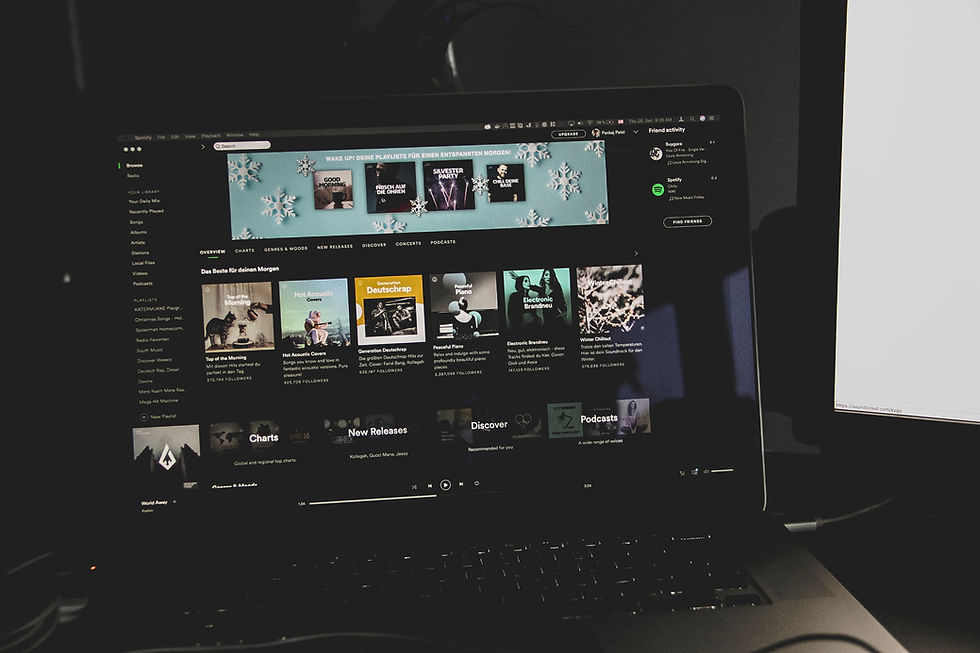
We zoomed in on the problem and realised that users find it difficult to use the various music websites on their laptops. They want an easier way to access and listen to music hassle-free.


Now that we know the problem and the target users, we ideated a solution.
*drum roll please*
A PLUGIN! (a pocket-sized app xD)
Sounds simple right? But...we searched and found no official music plugins available (both on safari and chrome)!!! We realised how huge of a user base they are missing out!
The Outcome 🎬
What was our final outcome?
But, we realised we didn't need to entirely design a new product...
When we realised that there were no official music plugin apps, we figured we didn’t need to create an entirely new product or brand. Since this was a passion project, we decided to just create a plugin for one of the existing music streaming apps primarily to save time on working on the UI language etc. After comprehensive background research, we chose Spotify!


Why Spotify?
-
Has an amazing growth: As of Q2 2021, Spotify had 165 million premium subscribers, up from 138 million in Q2 2020, more than doubling since early 2017. (Source: Statistica)
-
Best Suited for our User Base: The majority of our target user base is students and Spotify has the best student plans.
-
Our Preference: After usability testing with various apps (Amazon Music, Apple Music, YouTube Music, and Spotify), we personally preferred Spotify.

The Highlights 👀
What are the features my final solution boasts?


Distraction free seamless user experience
With an inbuilt plugin, you no longer have to struggle finding the right tab amongst your 5,353 open tabs. With just one click , you can access your music player.
Smart Music
Smart Music uses artificial intelligence to specially curate and notify playlists for you depending on what you're doing, to enhance your productivity.
Smart Music also automatically stops playing music when you have an event scheduled.

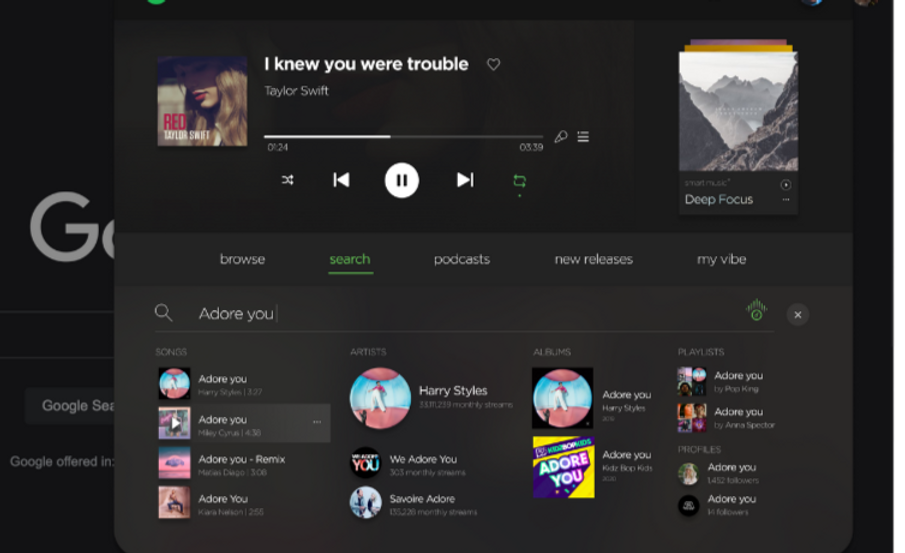
Voice Search
If you want to play a song but can't remember the name of the song, simply sing or hum while pressing the voice search button. The voice search will then recognise the song you're looking for, and display the results.
Spotify Vibe
Ever wondered what your music alter ego is? Spotify Vibe does just that. Spotify Vibe generates a unique Vinyl Record for you and identifies your Vibe based on your music listening habits.


Each colour represents your most favourite musical genres.
Number of plays
The size of each colour's grooves represent the relative number of songs played of that genre.
Personalised Playlist
Click on your Record to play a specially curated playlist that expresses your musical Vibe.
Merge & Party
Share your unique Record with your anyone, or even merge with your friends' Vibes to create the perfect playlist for any group of friends!
Find Friends, Chat & form Groups
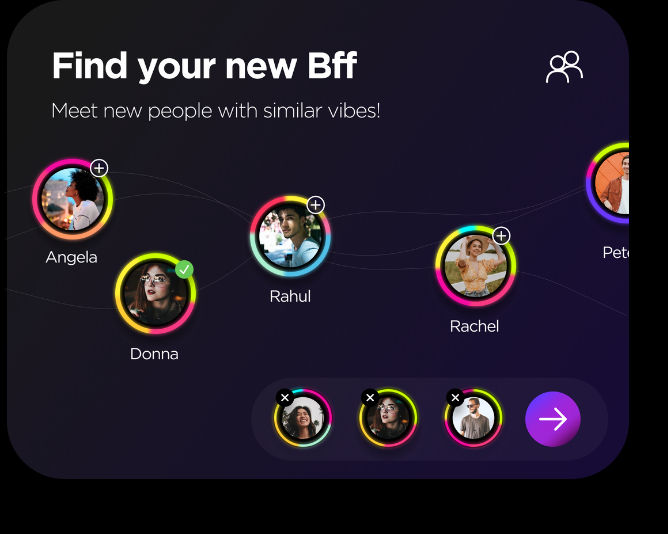
Make new friends by matching with global users with similar Vibes! Connect, have conversations, make plans to study, party or more with your Vibe Matches.
Make groups, invite friends and create events.
You can merge your Vibes and get a specially curated playlist for your groups of friends, new and old!


Explore your Vibe
Discover your Musical identity through My Vibe.

Top Genres
Find out your top genres and click on
any to play the Genre's playlists

Top Songs
Songs that define you,
songs that are your happy place

Top Artsists
Find artists that hold a
special place in your hear

Your Playlist
Play the specially curated playlist that
encapsulated your musical identity.
Learnings & Reflection 🧠
What comes out of this journey?
We learnt that UX Design takes a longggg time.
This project demanded immense effort and perseverance. Achieving our solution was far from magical; it was both time-consuming and mentally challenging. Keerthana and I often found ourselves at odds, and by the time we reached a conclusion, we were exhausted. We iterated on our problem statement multiple times, meticulously refined our solution, and revised our prototype countless times.
I learnt that "many hands make light work"
Working on this project with Keerthana was a delightful experience. It was not just enjoyable in a friendly way, but also intellectually stimulating. Our conversations sparked numerous ideas for this and future projects. However, we did procrastinate and sometimes got sidetracked, ranting about school. This caused the project to take much longer than expected, doubling our estimated timeline.
What would I do if I had more time?
At this stage, it seems every project stalls before usability testing. With more time, I'd prioritise testing and refine the six proposed features. Plus, I'd aim to pitch the idea to Spotify! 😄
Why did I choose to use diary studies?
Since we did not have an identified problem statement, using an online diary study seemed the easiest and most convenient way to find one. Let me explain.
Traditional user research methods posed challenges, especially starting from scratch. Asking broad questions like “What problems do you face with music streaming apps?” would unnecessarily complicate problem identification. Interviews require a large participant pool, are time-consuming, and often fail to elicit honest, comprehensive responses.
An online diary study, however, allows users to freely journal their experiences in detail. This method opened several avenues for exploration during this project and in the future. It's similar to researchers observing behavior in natural environments, providing equally accurate insights virtually.

IDENTIFICATION OF PATTERNS

RICH DATA COLLECTION

EASY & FAST EXECUTION
But, there was a catch. Conducting a diary study was not as simple and rosy as we expected it to be.
DIFFICULTY IN FINDING PARTICIPANTS
Since this research methodology is tedious, participants may be reluctant to join, especially if broke college students (hint: us) can't afford to pay them. To overcome this, we reached out to a larger group. Despite a low sign-up percentage, we had enough participants to identify patterns.
🙋♀️🙋🙋♂️
PARTICIPANTS FEELING UNCOMFORTABLE
Participants often feel too self-conscious on camera or online platforms to share their true opinions, especially negative ones. However, ensuring confidentiality and regularly checking in with participants helped build trust and encourage honest feedback.
😢😨😓
A TIRING RESEARCH PROCESS
Watching and reading users' online journals can be tiring for researchers. However, the invaluable insights gained make it worthwhile. To overcome this, focusing on the interesting and valuable insights keeps the process engaging.
😪🥱😓
Problem Statement 🎯
What problem am I trying to solve?
A majority of people working from home/students stream music from their laptops and the experience of doing so isn't so pleasant.
34% of the teens pay for a streaming subscription and a further 20% say they are to likely to start paying for a music subscription. With this enlarging user base, it is pertinent to streamline experience for all users. Though, WFH is mentioned in the problem statement, this could be extended to all individuals who work on their laptop on a daily basis.

Whose lives are we trying to improve?
Chandler Bing!
statistical analysis and data reconfiguration
advertisement agency
(he changed jobs, remember?)
It’s 2021 and Chandler Bing is tired of typing up slogans for various different advertisements while WFH cuz, obviously COVID-19. He is researching on TikTok Advertisements to stay with the trend. As he is researching, he would love to vibe with some music. But he finds it annoying to keep switching tabs to mute his music streaming website tab everytime he watches a TikTok Video (on his laptop, cus he is researching!). There are millions of people like Chandler who would love to hear some music while coding or ideating. It’s time to help them!

Chandler Bing
Executive Creative Director
Goals
Hear music while finding out marketing strategies
Browse through advertisement strategies (TikTok)
Join brainstorming calls and meetings to discuss upcoming plans and targets
Brainstorm slogans and captions for social media posts
Frustrations
Difficult to find the website I am streaming music from amidst the 30+ tabs open
How to find the right music to suit the mood? Especially while brainstorming and researching
Jumping between tabs to skip songs is a distraction
Tech Usage


Devi Vishwakumar
Highschool Sophomore
About & Behaviours
Devi is a studious high school sophomore. She loves sharing songs with her 2 best friends; Fabiola and Elanor. Despite the high school turmoil, she is a diligent student who spends hours in front of her laptop working on essays, presentations, and assignments. She loves to listen to soft music while working on her academics to ease the stress.
Tech Usage

Goals
Stream music while studying in the library or cafes, commuting or working out.
Distraction-free music while studying.
Stay up to date with the latest trends and hits in the music industry
Easily engage in a community with similar taste in music
Easily share music with cappella group.
Frustrations
Annoying to switch between multiple tabs and apps to find the music player
Free apps have a huge amount of distracting ads that play right in between in a song
Finding similar songs in the free version of youtube is redundant
Wants to be inspired to create innovate tracks

Writing a code?
Smart Music recommends the Deep Focus playlist, which evokes undeterred focus and helps you slide into a focused working rhythm while keeping the brain alert.

Playing a game?
Smart Music recommends the 2AM Zone-Out playlist, specially curated to completely immerse you into the game's world, to motivate you and improve your performance.

Developing a recipe?
Smart Music's whipped up a special musical recipe for you! Listen to the Bon Appétit playlist - It’s uplifting, it’s encouraging, and it’s strengthening. All the ingredients to help realise your latest culinary invention!

Creating your next piece of art?
Get inspired by the Creative Muse playlist recommended by Smart Music. Let the beats and melodies set the mood of your creative space and manifest your imagination.
This site was designed with love, patience, loads of ice cream & the need to find the right opportunities.